Monday, July 5, 2010

Oral History


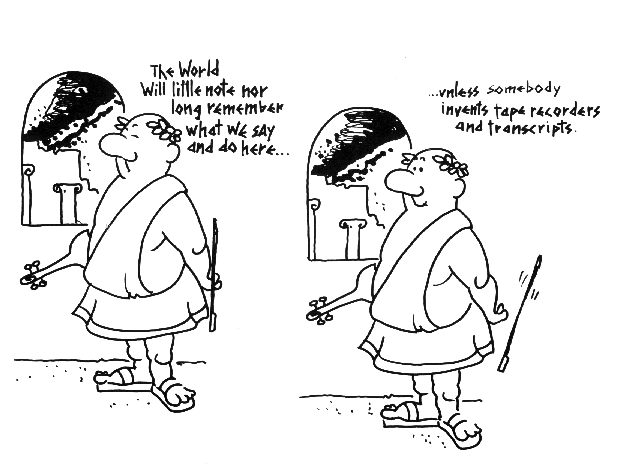
Our first week on the job, Larissa and I met with Amy Evans Streeters, a local artist and oral historian for the Southern Foodways Alliance, to receive guidance on our own oral history project.  The Southern Food Alliance (SFA) 'documents, studies, and celebrates the diverse food cultures of the changing American South'.   You may be familiar with Cornbread Nation - the irresistible collections of Southern food writing at its best, which just came out with issue #5.  Streeter, a lover of fresh oysters and a well prepared lemon meringue, has traveled far and wide to collect and document the stories behind southern food traditions.  On the SFA website you can find comprehensive transcriptions of this ongoing oral history documentation project.  

The goal of our initial meeting with Streeter was to simply get the basics for how an oral history is done.  Interviewing, recording, transcribing - the nuts and bolts of the process.  Reason being? Ben let us know that one of our tasks this summer would be to craft an oral history project of our own ambition.  Of course, our subject matter (the Mississippi Teacher Corps) isn't exactly in line with that of the hot delta tamale or gumbo trails, nor Southern BBQ or Kentucky bacon.  So the subject may be a little dry in comparison, and the work, well, altogether tedious, but I'll confess, I enjoy it and I've certainly learned a thing or two about MTC since its creation in 1990.  

One thing that frustrates me is that we have no real 'end product' in mind.  We were given the assignment without clear instructions for what it might look like upon completion or what goal it might achieve.  Today I was assured that it was an ongoing project and that Larissa and I are just laying the foundations for some time to come.  This I found reassuring as one thirty minute interview can take up to four hours to transcribe (Ben would argue otherwise but I am a fast typer and stand by my estimate).  So, I have let go of my own expectations that we will perfectly and comprehensively document the last twenty years of MTC in the little time we have left.  We are simply doing our best and enjoying the chance to talk with perfect strangers from all corners of the United States.  

Here's the gist of the project: Larissa and I are interviewing MTC alumni, program founders, past and current directors, program managers, and anyone else who might give us the time of day.  I have enjoyed the interview process so far, especially learning about how the idea for MTC evolved from a conversation between a Harvard journalism student and an Ole Miss graduate.  Neither of whom had any background in teaching in the Mississippi Delta.

I learned that the program did not originally offer the free masters degree in Education as it does today, this was an added incentive in 1994 and sets MTC apart from other teaching fellowships such as Teach for America.   

I have also learned that interviewing isn't actually all that easy.  I always suspected that the person on the 'asking' side had the easy job - just ask and wait.  But, as it turns out, I get uncomfortable with a pause of period of silence, I want to re-explain my question, rephrase it, ask it again until I am certain that I have communicated clearly.  This is an entirely ineffective way to conduct an interview and I am working hard to refine my technique: be clear, be concise, and be patient.  

We have only completed five interviews to date.  Three more are scheduled for this week, and one the following week.  

We've had some funny exchanges, some deeply insightful, and others altogether awkward.  One piece of advice: if you know you are being recorded, do not bad mouth your co-workers, past or present.  This just doesn't reflect well.  That being said... here are some exchanges I found interesting, inspiring, or just mildly entertaining:

BC - Betsy Critchfield
LD - Larissa Davis
HG - Harry Gaston

BC: Mr. Gaston, could we ask you to introduce yourself and what your position was at MTC?

HG: Yeah, I was the Program Coordinator for the Mississippi Teacher Corps from nineteen ninety-seven through two thousand, if memory serves correctly. I've been in Indianapolis with my wife, Maria, for the last ten years.  Both of us work for Eli Lilly Pharmaceutical Company.  I [currently] work, as a business analyst/business integrator with information technology systems.  

LD: Can you quickly describe some of your job duties while you were Program Manager at MTC?

HG:  Um, you-, you said the recorder is on, right?

BC & LD: Yes [both respond together and laugh]

HG: Ha...ha...ahhh... [still laughing] Ha...ha... no, the first thing that jumps to mind was getting Diet Cokes for Dean Chambless. 

I guess some of the duties of the interns never go away.  Not that I have ever been asked to buy diet coke for the boss!  Peanut M&M's, perhaps, trail mix, I wouldn't doubt it.  But, there was substance in that interview, too...

LD: Has the Mississippi Teacher Corps, working here and being a teacher, impacted your professional life in anyway?

HG: Well, most of the people I work with never did anything like this. I now work in the major pharmaceutical company and most of the people I'm working with are very career focused and never took time to pursue something like the Teacher Corps.  I think that it was just the most incredible experience.  I know that everyday, the relationships that I have, particularly with me African American co-workers is greatly benefitted from the time I spent in the Teacher Corps and the understanding I have, racially and economically. The experiences I had in Teacher Corps were just incredible.  The two years that I spent teaching in Tunica and experiencing what it's like to be a minority as a white person gave me a perspective that I most certainly couldn't get any other way.  Getting your hands dirty and getting in there and being apart of, really being apart of the failure -being apart of the system that's not working that well, understanding it, attaching yourself to it. The kids become your love and your interest and everything that you you talk about.  I am a native Mississippian so I wasn't unfamiliar with our education problems, but all of the problems that were academic and philosophical before became associated with these are people that I really care about and it hurts me personally to think that their opportunities are limited and that their choices are limited.  

I'll add one more thing, just the, the experience.... I always thought it was amusing when would be apart of the Teacher Corps and even just after and people always talked about how wonderful it was what you were doing, you know.  And most people, they have no clue how much you gain as a participant, how it changes your entire life, how it changes the way you see people.  

Most of us, and by "us" I specifically mean white middle-class people - my perspective as a white male southern person - we don't even like to talk about race, it's a discomfort.  And, the reason that we don't it that we don't really understand our place in all of it.  And, this program gives a perspective you just couldn't get any other way. 

The program also gave me the opportunity, gave all of us as participants the opportunity to meet some of the people who were making incredible difference in education, in Mississippi society.  Governor William Winter, Andy Mullins, and then Governor Ronny Musgrove.  We got to meet those guys and not just talk to them.  They had so much respect for what we were doing.  They gave us insight into their own work and we were really apart of helping to change the face of education in the state. I've never done anything in my life more fulfilling than than the five years that I spent with the Mississippi Teacher Corps, and I wonder if I ever will.  I'm making an awful lot more money now but I don't have anywhere near the sense of fulfillment that I had when I was working with that program.

This is just a very brief clip of one of our shortest interviews. So, as you can tell, there is a great deal of praise to be given. Still, I am interested to learn more about the program's faults and the areas in which it can improve. I think it may take a bit more probing to uncover as people generally don't like to point out their own weaknesses, but I am certain that if we ask the right questions, we may uncover some equally interesting material. Until next time....


Thursday, July 1, 2010

A note on punishment

Consistently over the past month I have heard again and again from the second year teachers, "you must be hard on these students. It isn't easy, but you've got to enforce discipline." At first, I was surprised and unclear by what this meant.  What about compassion and understanding?  "Always question their motives," I remember one teacher saying to me.  In my primary school, discipline meant a one-on-one confidential talk where both sides were expressed and listened to.  It wasn't publicized and usually just involved the student and teacher.  The entire discipline process here in the Mississippi public schools is entirely foreign to me, to say the least.  While I am trying to keep my 'beginner's mind'engaged (a Ben Guest-ism), I can't help but feel upset by an exchange I witnessed between a staff member and a student not too long ago.  

 A young man was sent to the summer school office for detention for talking fresh to his teacher, or something to that effect. Undoubtedly, the student's actions were out of line and it was clear that he was upset.  It was right to remove him from the classroom at the risk of causing greater disruption to the other students, and to give him a chance to cool off. When he arrived at the the Principal's office he was a bit defiant, but certainly non confrontational.  Then, the MTC summer school principal began to scold the student before even listening to the entire store.  And from there, the whole situation went south.

It wasn't the words the Principal chose so much as how he chose to deliver them.  The situation escalated, the child was provoked and defensive, and I couldn't blame him.  Yes, children can ere and make mistakes, talking back without much restraint until through experience they learn better (believe me, I am still learning how to do this, my parents can attest).  But when a figure of authority uses a condescending tone in a provocative way to discipline, isn't he just setting a bad example, perhaps even being hypocritical? 

When the Principal had had enough, he left the room to attend to other issues and I was left alone in the room with the still fuming student.  I could see the hurt and frustration on his face, and it was then that the underlying issue emerged -it was a power struggle.  The student sat scratching at his desk with the tip of his eraser, he was assigned to copy President Obama's inauguration speech.  I could just barely make out what he said as he mumbled under his breath, "I ain't gonna apologize to him. He ain't gonna win. I'll apologize to her [the teacher]...I wanna apologize to her, but not to him."  At this point, I was on his side, if I were picking sides.  The Principal had asked for an apology and he wouldn't deliver.  "My father taught me never to give in to a white man," the boy said, and that's when I knew that this issue was deeper than I'd thought. 

It was a classic power struggle.  And as others have told me, you have to understand where these kids are coming from in order to communicate effectively with them.  I think this applies to teaching and to discipline.  

When I left work that day, several questions coursed through my mind: (1) Was this a male thing that I couldn't understand? (2) Or, could it be an issue of race (black student/white principal)? (3) Could it be a combination of race and gender? 

The student was a black male about to be eighteen - a man by America's definition. The Principal, an MTC employee is white, male, and probably not much past the age of thirty.  He has had years of teaching experience in the Delta and other parts of the South.  

The racial differences were obvious, but could that really be the sole fuel for this confrontation? 
Maybe there is the inherent force of the biological competitiveness of males at play.  And this effect compounded with the socially constructed racial tension served as a fatal calling for disaster. 

I can't say for certain why this confrontation went awry.  I'm no expert and I wasn't present for the initial exchange between teacher and student (white female/black student).  However, from my social psychology class with Professor Sanderson last Spring,  I've come to understand that "history informs behavior".   That is, our present interactions are heavily shaped by past our experiences and exchanges.  

From where I stand, administrators, faculty, staff, and other authority figures should enforce their rules with rigor. Most of the students in the schools that MTC teachers are teaching in come from poverty or low income households.  Maybe they have a single mother for a parent, perhaps a father if they are lucky.  They might be living with a grandparent, aunt, or uncle.  Sometimes there is no figure out authority in their lives.  They are crying out for structure, for discipline, for some kind of regularity and dependability in life.  For this reason alone, those of us in positions of authority must chose our words carefully and make every conscious effort to supply discipline in a respectful way.  When a Principal speaks to a student, black or white, male or female, he ought to bring the student up to a level where they expect them to be.  We can't 'baby' them, but we mustn't beat them down either.  

Monday, June 28, 2010

From the outside looking in - Greenwood, MS


On Saturday afternoon, the three interns guided by Ben and team teacher Ashley Johnson all piled into the University van for our first trip into the Mississippi Delta.  Our first destination was Greenwood - headquarters of the Viking Range Corporation - and then we were on to Money - the now vacant town once home to Bryant's Grocery.  The trip was one I will never forget.  The sights I saw opened my eyes to a part of our nation I could never have imagined, neighborhoods so poor and distressed you might as well think you were in a third world country.  

The small Delta 'city' of Greenwood, Mississippi was first introduced to me by Ashley Johnson, the bright and passionate young MTC Team Teacher who spoke to us about her experience as a teacher at the Greenwood Middle School a few weeks back.  Ashley supplemented her verbal description of the area with a simple diagram; a river (the Yazoo) running parallel to a set of train tracks divided the picture plane in two.  On one side, she indicated the affluent, upper class neighborhoods inhabited primarily by white families and wealthy Viking executives. Across the river and on the other side of the tracks that once rattled day and night with whistling trains piled high with mountains of cotton, she noted the now crime-ridden impoverished black neighborhoods.  Boy, did I not have any idea what the Delta was really going to be like.

The Mississippi Delta is a legendary part of America and its history.  The dark nights of lynchings and burning crosses; the gothic complexity of Faulkner’s tales; the horrific legacy of plantations and slavery; the sweet smell of the magnolia tree on a summer's night; the blazing morning sun rising over endless fields of cotton.  I saw it all too well; battered shacks that house the poverty-stricken descendants of slaves; the riverbanks where water moccasins and fire ants threaten; the calm muddy Yazoo and Tallahatchie rivers that have swallowed countless bodies of murdered black men.  And more still, situated within the decrepit slums, we found Baptist Town - the birthplace of the blues; the place where cicadas sing in cacophonous vocal experimentation all night long; and finally, the overlooked origin of some of the raw beginnings of the civil rights movement right there in Money, Mississippi.  Each of these descriptions is a mere glimpse of the delta that is a inextricably apart of our national mythology.
 
In the Delta I was perhaps most struck by the contrast between the vibrance of the fertile land and the unavoidable sense of decay in the black neighborhood.  "My kids from this neighborhood, they had a particular smell, you knew where they were coming from," said Ashley Johnson as we drove down Broad Street in Greenwood.  She taught many young children from this area just a few ago.  She could still remember their names, which houses their aunts and uncles lived in, and the corners they used to frequent.  Most of these children never make it out, we were told.    

Imagine a small ghetto a world away with ramshackle shot-gun shacks lining the streets, shower curtains for front doors and sheets covering the broken window panes.  There were blocks where virtually every storefront was empty and people were just aimlessly hanging out, as if waiting for something else to happen.  The liveliest pockets in many of these neighborhoods were around children.  A lonesome boy road a flat-tired bicycle in front of a barren Baptist church.  There is at least one liquor store for every church in the area, and there were a lot of churches let me assure you.


These are the poorest of the poor, their ancestors once slaves and sharecroppers.  Today they are deliberately cast aside, ignored, not discussed, given little attention or care.  They endure lives of poor education, poor health, limited opportunities, and rampant crime.  There are those who loudly proclaim that the poor of the nation should “pull themselves up by their own bootstraps,” but such proclaimers have most always lived lives of relative privilege.  The desperate poor often don’t even have the boots … and the delta can be an inescapable trap.

As Ben has told us again and again, the Delta, and in particular the small town of Money, was significant in igniting the modern civil rights movement.  In 1955, 14-year-old Emmett Till, a black boy visiting his family from Chicago, apparently wolf whistled at a white woman while visiting Bryant’s Grocery.  Mrs. Bryant told her husband and in the dead of night Emmett Till was kidnapped, beaten, murdered, and thrown into the Tallahatchie River.  The accused murderers were acquitted in under an hour by an all-white jury.  The story brought outrage across the country and was a tragic start to the march for racial equality over the decades.   

Finally, the last stop on our journey was Bryant's Grocery. As I gazed up at the now crumbling store front, I felt a wave of grief and disgust come over me.  Sadness for a naive Emmett Till, for his mother, his family, and for all those who lost their lives or suffered any kind of social injustice, prejudice, racism, or segregation.  There was no monument, no marker, nothing to indicate the profound importance of this location in our nation's history.  The historical footage we've seen in documentary films shows a bustling town with one store front after the next.  Of course, that was then.  Now, the rotting frame of this one lonely building and is all that's left.


Thursday, June 24, 2010

In a nut shell


This photo comes from our weekly speaker series - here listening to Dr. Germain McConnell.  Early Tuesday morning, Larissa and I arrived at Guyton Hall to begin our days work.  We found the building eerily empty, warmer than usual, and rather dark.  It didn't occur to either of us that the power might.   Ben was no where to be found.  Sure enough, the power was out for the entire campus for much of the day.  The outage occurred as a result of a cooling failure on one of the transformer fans in the Rebel substation, we later learned.  The outage made for dreadfully hot, "character building" cycling class later that afternoon in gym without air conditioning.  When the heat index hovers consistently around 105 degrees, it made for a hot afternoon.

On the whole, however, things ran pretty smoothly this week.  Monday night was 'spa night', hosted by Team Teacher Danielle Hall.  Two generous ladies from a local spa donated their time and services to a dozen or so exhausted teachers (and interns).  It was a relaxing start to the week.  Even some guys showed up to get their lips exfoliated and scalps massaged.  

Tuesday morning, I thoroughly enjoyed listening to Dr. McConnell - Director of Field Experiences, Co-Director of the Mississippi Teacher Corps, Assistant Dean, and Assistant Professor of Leadership and Counselor Education.  He cracked us all up with stories from his undergraduate years at Ole Miss and also spoke about his life's work in education and as a Minister.   After the conversation, Ben treated us all to lunch at my new favorite place in Oxford, Honeybee Bakery .  We sat outside in the blazing sun sipping iced Moroccan mint tea while Ben gave us a little lesson on tax history and the funding of public education.  We discussed ideas about how to increase prosperity of the poorest families living in the Delta. 

White flight from public education (yes, I am guilty here) leads to a case of moral hazard, especially here in Mississippi.  And, you don't have to just read it to believe it.  At the Holy Springs summer school - held at the town's high school - all you have to do is look at the portraits on the walls of the graduating classes.  After about 1970, the population of white students, previously making up a good percentage, has continued to dwindle down to maybe one student in the graduating class of 2010.  The white children are surely vacating the public schools for private education.

In the flush town of Oxford, Mississippi - Lafayette County - the desperate scramble for enrollment in prestigious private schools does not apply.  Parents here generally think highly of their local public schools, as we learned from Mr. & Mrs. Barksdale.  Though I haven't done my research, I bet in this economy that the nearby private schools have some empty seats and turn away relatively few students.

Still, I know that in my own hometown of Portland, Maine, the well known private schools - Waynflete, North Yarmouth Academy, Thorton Academy, Chevrus, McCaully, Breakwater School, to name a few - survive on the qualities that set them apart from public schools: small classes, flexible curriculum, sophisticated courses, and a bit of freedom.  The differences are so clearly understood that they are rarely made note of.

But I can't help but notice, the Oxford University School has been advertising in local newspapers — a departure, in itself, for many private schools — with a pitch subtly pointing out that at a time when the nation's public schools are cutting back and consolidating, private schools are not.

The advertisements come at a time of paradoxes.  The recession that has prompted public schools to trim programs and increase class sizes, making private school more appealing, has also left parents less able to come up with the $25,000 to $30,000 a year charged by many independent day schools. And for private schools, taking advantage of the perceived vulnerability of public schools is a chance to shore up their own battered finances.

It is all still a bit confusing to me, there are a lot of unanswered questions.  But, this internship has certainly given me the opportunity to reflect on my own primary education.  If I could do it over again, would I go somewhere else, public school even?  I wouldn't.  If I could give the gift of  Waynflete to every student in this country, I would.  As I see it, the only way I think I could come anywhere close to that goal would be to go into education myself and invest in a most desperate and failing system - the nation's public schools.  

What's in store for the weekend: Saturday, a trip to Greenwood & Money, Mississippi with Ben and Ashley Johnson, another Team Teacher.  We will go to the very shop where Emmitt Till evidently wolf whistled at the shop keeper's wife, which ultimately lead to his brutal murder. I am excited for this trip, especially after watching three installments of the Eyes on the Prize documentary series covering Emmett Till, James Meredith, and Medgar Evers.  Sunday, I may finally get to sleep in past 5:30 am.  I have dark circile under my eyes, though I still shoot out of bed at each morning not wanting to miss any of this great adventure.  Until next week...

Does America need an Amendment to the US Constitution to improve Public Education?

On Monday, Ben handed each of us a copy of a recent report by the Southern Education Foundation, (link) entitled, 'No Time to Lose; Why America Needs an Education Amendment to the US Constitution to Improve Public Education.  It is pretty comprehensive, and thus lengthy, but here are some of my thoughts and reactions.

There is little doubt that Bush's 'No Child Left Behind Act' isn't turning out results and that a new initiative on education is desperately needed.  However, with the ongoing War on Terror, the oil crisis in the Gulf Coast, and the new hugely expensive Health Care bill, I'm not hopeful that public education is a nagging priority of the current administration.  The idealist in me believes that neither race, location, nor class should be predictors of the quality of public education provided to students.  Soon enough the country will have to address the status quo of public education: an inadequate system of inequitable opportunity allocation.  Of course, those who suffer the worst are the millions of low income -mostly black - students.  As far as money is concerned, the data all points to one near victory: the 'race to the bottom' in a competitive global economy.  

The essential components to establish a basic infrastructure of an sufficient public education system are clear: good teachers, adequate facilities, quality instructional leadership, counseling services, security, libraries, text books, technology, aligned curriculum to high standards of achievement and expectation, after school services, funded pre-kindergarten (non-existent in Mississippi), professional development, to name the basics.  Schools and school districts that fall short of the funds for such essentials shortchange their students.

The calculations are simple, too. Students who endure an inferior education perform significantly worse on standardized tests and other state mandated measures of proficiency compared to those who receive an outstanding education.  Students can't learn unless they are taught by a capable team of teachers and administrators.  Those from an educationally or economically stressed background especially need extra instruction and guidance to make any gains in school.

As I understand it, the "resource and finance" gap abets the "achievement gap".  The SEC report addresses the more frequently pushed under the rug issue of the disconnect between desired achievement ends and available resource and finance means to achieve those ends.  Aren't we just weighing the cow, rather than considering how to ensure that it is well fed?

What is the federal role in regards to funding and providing for public education?  It is unclear and variable, at best.  No Child Left Behind and other partially funded mandates indeed set aspirational standards.  However, without the funding that enables all states to defray compliance costs, such measures are just but small steps in the right direction.

I haven't come across any sound argument for the effectiveness of the highly decentralized system of public education allocation that America now has.  Certainly it is not the most efficient and effective method of ensuring that all students, regardless of the neighborhood they come from or their own parents' education, are treated fairly.  While formal equal opportunity is on the books, we continue to deny the millions of low income and minority students the opportunity to cultivate the tools necessary to capitalize on equal opportunity through improved education.  Check out the link I provided, and see if you can be convinced.  You can also check out John Stossel's Stupid in America for some more commentary.


Tuesday, June 22, 2010

Just do it

My philosophy for this week is rather simple; just do it.  Don't think too hard about things and keep moving forward, I tell myself.  We have three blog entries to post before Friday in addition to the usual workload (a bit more than the previous weeks).  With that in mind, this morning I will address the first assignment; re-reading the the blog of one MTC alumnus.  

Ben asked that we read from beginning to end (two years of entries, mind you), the blog of a former MTC-er.  I have been reading bits and pieces of past blogs all along, as I find them informative as well as stimulating for when it comes to writing my own entries.  They offer little glimpses into the personal experiences that might otherwise never be exposed.   

I came across a blog link entitled, 'Texas', and decided to go with it.  I am a native Texan mysel, so naturally I was curious.  The blogger's name is Hunter Taylor. By luck of the draw, I turns out that I happen to know Hunter.  I met him at the gym my first week here.  Although he completed the program and is no longer teaching in the Delta, he is still heavily involved with MTC as a "team teacher".  

Hunter is one of eleven other alumni who have returned this summer to help evaluate the second-year teachers as well as teach at the Holy Springs summer school.  Now that is dedication.  We have joked around quite a bit, hung out together, worked out together, but he has never gone into great detail about the specifics of his experience in the classroom.  Needless to say, I had quite a bit of reading to catch up on in order to find out more about his experience as a teacher in the Delta.  

Now, the blog doesn't read like a day-to-day journal account, though it is sufficient in painting a picture with a broad brush of life in the Delta public schools. The entries I enjoyed reading most gave specific accounts of events - a play by play recount of a nail-biting state championship basketball game following a tumultuous season.  Immediately, I was brought back to the court, or field rather, of my own state championship games.  Reliving through his description the enormous effort required to reach that level of competition.  But it was the tough circumstances of his team that particularly stood out to me - a product of a relatively affluent northern private school. Take a glance at his team description:


Poster Children for Perseverance

I was talking with one of my assistant coaches the other day, and I am quite certain that I have never been a part of a team or heard of a team that has had as much turmoil on it. Let me give you a brief recap of how we started the year, and what our current status is. In order to protect the anonymity of my players, however, I will not be referring to them by name. We began the year with 15 players. Ten of them were 8th graders and five of them were 7th graders. Then the season started...haha. We’ll begin the year by what happened first to player 1. 

Player 1(that’s how I’ll refer to him) was caught with a fire extinguisher hosing off another student. Result…..45 days at alternative school and automatic dismissal from the team. 

Player 2 then decided to run from the school’s security guard on two separate occasions. Result…..3 days school suspension and automatic dismissal from the team as ordered by administration. 

Player 3 then missed multiple practices with no excuse, and was caught by an administrator with a bag of marijuana. Result….dismissal from the team. 

That’s 3 people gone….try and keep up now.

Player 4 missed multiple practices with no excuse and is currently being investigated for having an improper relationship with a girl in one of the school’s portables after school. Result, dismissal from the team. 

Players 5, 6, and 7 all failed four of eight classes for the first semester. Result…..dismissal from the team due to state and school policy.

That’s 7 people gone….we have 8 people left.

Of the 8 players that are left, we have…..

Player 8, who has a sprained toe, will be out of action for the final home game.

Player 9, who has already served a one-game suspension for disciplinary matters and currently faces a “last chance” team policy from the coaches. 

Player 10 is still dealing with the shooting of his brother, which occurred two months ago. 

Player 11 was suspended last game by his mother for skipping a class, and is still under the microscope from her as to whether or not he will be able to play for our last home game.

Player 12 has a pulled thigh muscle that he hid from the coaches, until his mother finally came and told us. (He’s a warrior, he’s our Captain, and he’s still playing)

Players 13, 14, and 15 are great kids who seem to have lost their confidence the last 2 games.

I think the one aspect that I’m most proud of our kids that are still playing on the team though is how well we’ve persevered. Our current record is 7-1 overall and 3-0 in conference. Of our 7 victories, we’ve won 5 of them by single-digit margins. This past Thursday, we also clinched the division title, and reserved our spot for our school’s fourth straight City Championship game. Our school, however, hasn’t won the championship in over 5 years, and I can’t think of a more perfect ending than for a group of wildcards to somehow band together and pull this thing off. I guess we shall see in about 2 weeks.

I'm told this case is not unusual.  But how remarkable it is that Hunter didn't allow his frustration to override a team's potential.  Coach Hunter isn't an exception.  Many MTC teachers are coaches, club leaders, mentors and advocates.  It's a job title with many hats.    

I bet Hunter was far more than a basketball coach to these young students.  It takes a lot to gain trust, you must show up day after day to show that you care about someone.  Tutoring to retain failing kids.  Coping with the shooting of one young man's brother.  

Thursday, June 17, 2010

Weekly Re-cap

bookSomehow, the days just keep getting better and better. My mom is pretty famous for saying "that is the best [chose your food] I have ever had, ever, honestly!" My father and I just laugh and try not to roll our eyes; because, really, how many bests of the same sort of food can can you have? You should only be able to say that line once per category, I would argue. But lately, I confess, I am beginning to feel the same way about my experience here with the Mississippi Teacher Corps. At the end of each day, I find myself thinking, "wow, those were the most inspiring people I have ever met, ever, honestly!" Or, "now that was the best day yet."

Week three has been a thrill. I am beginning to nail down a routine; I wake up at 5 AM with Larissa before she heads off to Holy Springs summer school to work in the office. I try and take my run through Lamar Park before the heat index reaches 105 degrees later in the day. I read the handy online NY Times Digest while I eat breakfast and then savor my fifteen minute walk to work through the beautiful University campus beneath towing magnolia trees.

Larissa and I alternate working here at the University for Ben one week to helping out at summer school. So, in answer to many of the questions I have received - no we do not actually teach. At the MTC office I am working on converting all of the MTC paper files to digital files, a rather daunting task at first, but by this point I see progress and that is encouraging. I do whatever Ben requests; fax, file, phone calls, spreadsheets, errands, you name it. Ben has high expectations, but keeps it fun, that's just the kind of person he is and just the way I like it.
As apart of the MTC Internship, Larissa and I get to meet, listen to and talk with a wide variety of people who are in some way deeply involved with public education in the state. This Tuesday, the other interns and I were fortunate enough to meet Claiborne & Marian Barksdale at the Barksdale Reading Institute (BRI) right here in Oxford. At the University of Mississippi, Oxford, the Barksdale name has come to be associated with a true dedication to improving life for all Mississippians through vision, innovation, execution and philanthropy.
I find it awfully surprising that the state of Mississippi, while home to generations of literary giants such as William Faulkner, John Grisham, and Richard Wright, ranks dead last out of all state literacy rates. It is also last in the dollar amounts spent on each student in its public school system, competing with Alabama, Tennessee, Arizona, and Utah. High poverty levels combined with a lack of funding for remediation, materials, and teacher training exacerbate the critical problem. This is where MTC and BRI are working to eliminate the gap.
In the year 2000, Mr. and Mrs. Barksdale, both natives of Mississippi, decided that the reading levels in the Magnolia State were unacceptably low and they became determined to reverse the trend. The family donated $100 million dollars and founded the BRI. Claiborne gave us a detailed account of the ways in which the Institute has significantly improved the reading abilities of children in kindergarten through the third grade in more than 70 under-performing Mississippi public school, in addition to the pre-literacy levels of children from birth.
Here's how it works: the BRI formed partnerships with the state's public school system, the Mississippi Department of Education, as well as the state's public Universities to create 'systemic' reform in the way reading is taught to children across the state. To save myself from paraphrasing, I encourage everyone to visit www.msreads.org/ to learn more about this critical effort.
This has really been a small recap of what I learned in one morning this week, but there were so many other things going on as well. On Tuesday afternoon, Larissa and I interviewed Dr. Whitney Webb to begin our oral history project about MTC. Thursday, I continued the project with an interview with Dr. Mullins - the Co-Founder and Co-Director of the MTC program. The workload in the office has been significant and constant, but I so enjoy it!
(Attentive notetakers while listening to Marian Barksdale talk about her work on the PTA and as a tutor)


And, here with Hallie sitting on the great porch of the BRI before lunch


Yesterday afternoon, my mom popped into town for a quick visit. It is so lovely to have to opportunity to show her a glimpse of what I have been excitedly writing home about for several weeks now. After a trip to the Taylor Farmer's Market on Saturday morning (I am dying to buy a handmade wooden salad bowl), we will travel north to visit a dear old family friend in Germantown, Tennessee. We plan to go to the Civil Rights Museum and I hope, visit the cul-de-sac where I first learned to ride a two-wheeler at age three. Next week I will be in Holy Springs so expect some updates from there!